Social media done right.
Ever opened social media for ten minutes and looked up two hours later? We are building PureTag Social to fix that. You choose your interests, broad and specific, and your feed follows them: posts from people who share what you care about, delivered in batches that end when you say so. We will make money from premium features and limited, clearly labelled advertising, not by exploiting your attention. On PureTag, you're the customer. Not the product.
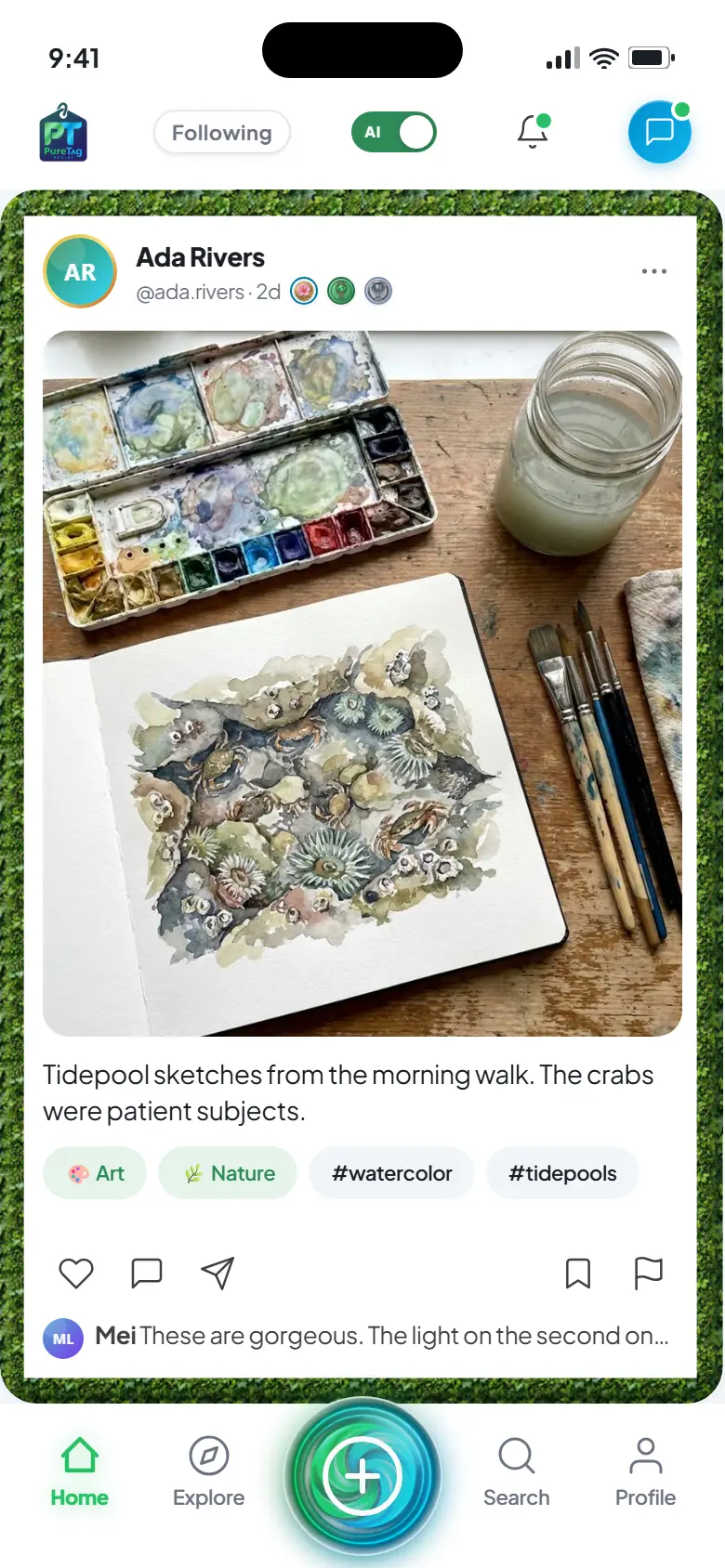
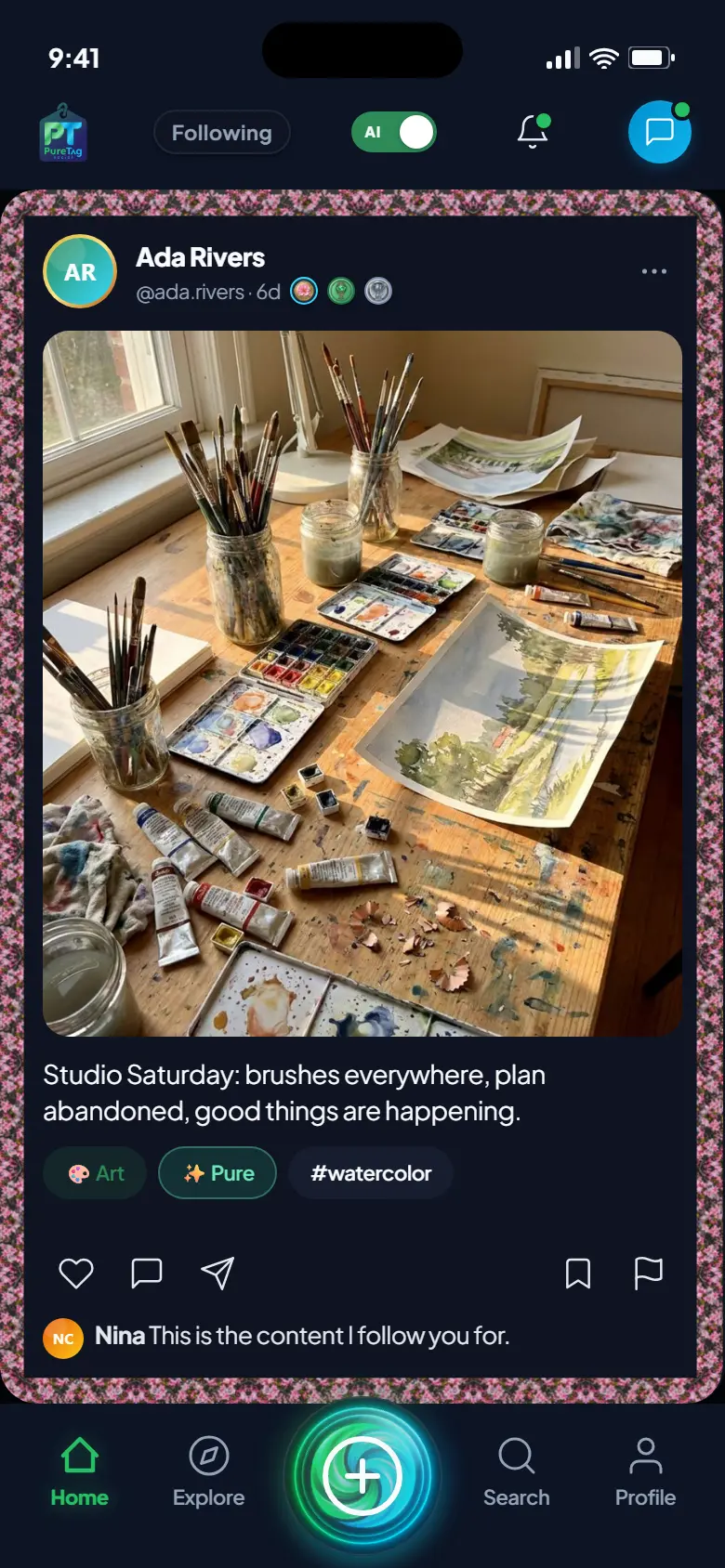
Screens from our prototype, a demo of the app, with sample users and posts, not real people. PureTag is in early development, and what you see here may change before release.
A for-profit company on a different foundation.
PureTag Social is a business, and we are building it to prove a point: a social platform can serve the user and the business alike. Every element of the platform is designed to prioritize your experience instead of extracting your attention, and the company is built to make money when you are satisfied, not when you are manipulated.
How the big feeds make their money
Modern feeds are engineered to hold you, and the people who built them have said so. Facebook's founding president, Sean Parker, described the design question as "How do we consume as much of your time and conscious attention as possible?" and described the dopamine hit of likes and comments as "a social-validation feedback loop" that exploits "a vulnerability in human psychology".1 Aza Raskin, who designed infinite scroll in 2006, told the BBC that "behind every screen on your phone, there are generally like literally a thousand engineers that have worked on this thing to try to make it maximally addicting."2 Tristan Harris, formerly Google's design ethicist, compares pulling out your phone and scrolling a feed to playing a slot machine: the same intermittent variable rewards that keep a gambler pulling the lever.3
It works. The typical internet user spends two hours and twenty-one minutes a day on social media.4 More than four in ten US teens say they spend too much time on it.5 The US Surgeon General's 2023 advisory reports that adolescents who spend more than three hours a day on social media face double the risk of depression and anxiety symptoms.6 Meta's own researchers wrote, in an internal slide summing up research on teen girls who said they already had body image issues, that "we make body image issues worse for one in three teen girls".7 In October 2023, 33 states filed a federal lawsuit against Meta alleging it designed and deployed features on Instagram and Facebook that addict children and teens; with Florida, the District of Columbia and seven more states filing their own actions the same day, 42 attorneys general in all.8 Meta denied the allegations, and the August 2026 settlement described below was entered without any admission of wrongdoing.
The reason is the business model. Meta earned $164.5 billion in 2024, and roughly 98 percent of it came from advertising.9 When advertisers are the customer, your attention is the product, and a feed that holds you longer is a better product for the people who actually pay.
These figures describe the platforms people use today. They are not a promise about PureTag, which is in early development. What we can show you is how it is designed, and the rest of this site does that.
Your experience, not your attention
Product first, the traditional way
Extraction has a shelf life
A better product wins
We think a feed built to trap people is a weakness, not a strength. A product people resent is a market waiting for a better one. Most people are not leaving the big platforms, but plenty of them wish they used them less,5 and even the incumbents are being pushed toward user control: Instagram extended its "Your Algorithm" controls to the main feed globally in June 2026, and Meta's August 2026 settlement with state attorneys general requires it to give US teens the option of a non-personalized feed as their default, plus a default two-hour daily limit and a block from its apps between midnight and 6am.10 None of that is a feed that arrives in batches and ends when you say so.
Our bet is simple. Build the platform users actually want and they will choose it: a feed that follows the interests you chose, explains itself, and ends when you say so, paid for by things you actively choose and by advertising that is limited and labelled. That is how we intend to win the product war. Not by holding you longer, but by being the one you would pick. PureTag is in early development, and what we describe here may change before release.
Our promise is simple: we will be transparent with you, and we will never mislead you. We do not think that should stop with us. We are working on something to help spearhead an ethical movement throughout the corporate world, and there is more coming on it in the near future. Ethics is not a PR campaign here. It is the operating system.
- Axios, "Sean Parker unloads on Facebook", 9 November 2017.
- BBC News, "Social media apps are 'deliberately' addictive to users", 3 July 2018.
- Tristan Harris, "How Technology is Hijacking Your Mind", May 2016.
- DataReportal, "Digital 2025: the state of social media" (GWI data), February 2025: the typical internet user spends 2 hours 21 minutes a day using social media.
- Pew Research Center, "Teens, Social Media and Mental Health", April 2025: 45% of US teens say they spend too much time on social media.
- Office of the Surgeon General, "Social Media and Youth Mental Health: The U.S. Surgeon General's Advisory", 23 May 2023, citing a longitudinal cohort study of 6,595 US adolescents aged 12 to 15.
- The Wall Street Journal, "Facebook Knows Instagram Is Toxic for Teen Girls, Company Documents Show", 14 September 2021. Full text in the House Energy and Commerce Committee record, congress.gov.
- California Department of Justice, "Attorney General Bonta Files Lawsuit Against Meta Over Harms to Youth Mental Health", 24 October 2023; People of the State of California et al. v. Meta Platforms, Inc., No. 4:23-cv-05448 (N.D. Cal.).
- Meta Platforms, "Meta Reports Fourth Quarter and Full Year 2024 Results", 29 January 2025: revenue $164.50 billion, advertising $160.63 billion (97.6%).
- Meta Newsroom, "Our Agreement With Bipartisan Attorneys General", 26 August 2026, and the consent judgment in No. 4:23-cv-05448 (N.D. Cal., Doc. 572-1); Instagram, "Control Your Instagram Reels Algorithm", updated 10 June 2026.
We quote the people named in this section from the public record. None of them is connected with us, and none has endorsed PureTag.
Designed around what you are into.
You choose from sixteen ThemeTags and add your own YouTags inside them.
Sixteen ThemeTags, fixed. Pure is a ThemeTag for wholesome, uplifting content. Add it to your feed if you want more of it. Skip it if you do not.
A revenue model that ads to the experience. Money will come from optional cosmetics, an optional ad-free premium subscription, and clearly labelled sponsored posts. By design, at most one sponsored post per batch, at the top, always labelled Sponsored, and none at all for Premium subscribers. PureTag is in early development, and these details may change before release.
One email a month, and immediately when there is something real to show.
What arrives: notes from us on building PureTag, and the announcement of our Kickstarter campaign, which this list hears first, followed by campaign news while it runs. How often: roughly monthly, and more often while the campaign runs. How to leave: one click, on every email.
Get in touch. We would like to hear from you.
Questions, ideas, press or partnership enquiries: write to us here, or at hello@puretag.social.